Gaining Perspective for Progress
Four Helpful Questions

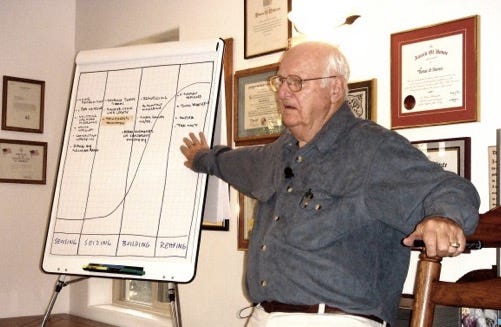
Tom Paterson, Master Facilitator
Looking for a straightforward yet powerful way to evaluate your current reality and chart a course for the future? Strategy and planning pioneer Tom Paterson, the architect of the renowned "StratOp" process, offered a remarkably simple approach: "Perspective before Planning." This foundational principle, now carried forward by the Paterson Center, encourages us to thoughtfully assess our present situation before diving into strategic action.
As Pete Richardson of the Paterson Center articulates, this principle translates into a set of essential inquiries:
"We call it the four helpful lists, things they could ask right now like first, in my life personally, and my family, vocation or work and in my community, what’s right? It may not need to be perfect, but it’s right … Make a list of everything that’s right. And then number two, ask the question: What’s wrong? What really should be right and needs to be changed? I don’t have to solve it right now, but let’s make what’s wrong visible. Be honest, be true. Three: what’s confused? What needs clarification of some kind? I don’t know if it’s right or confused or missing or whatever. It’s just like, there’s fog around it. And then lastly, what’s missing something that needs to be added? What feels void?”
The power of these four questions can be found in their simplicity - they work in a board room as much as they do on the back of a napkin in a cafe
These four fundamental questions form the bedrock of effective evaluation, applicable across personal, professional, and communal spheres. While our primary role as leaders often involves looking ahead and envisioning the future, Paterson’s wisdom reminds us that genuine progress is rooted in honest self-assessment. Without taking stock, we risk moving forward without truly knowing if we are on the right path or simply perpetuating existing patterns. Evaluation provides the concrete evidence to support our intuition and guide our steps.
The beauty of this evaluation framework, often referred to as the "4 Helpful Lists," lies in its transferability. Engaging teams and stakeholders in this process not only enriches the feedback we receive but also empowers them to adopt this evaluative mindset in their own spheres of influence. As one organization, Intentional Churches, discovered while developing clear vision and strategies for growth, these four simple questions can become more than just a tool; they can evolve into a fundamental way of thinking.
Before embarking on this evaluation, however, one crucial question must be addressed with absolute clarity: WHAT ARE WE REALLY TRYING TO ACCOMPLISH? Surface-level metrics can be misleading. True evaluation requires us to dig deeper and understand the underlying purpose of our efforts. For instance, increasing group participation is only meaningful if it leads to genuine connection. Defining our core objectives ensures that our evaluation focuses on what truly matters.
Let's explore the four helpful questions:
1. WHAT IS RIGHT?
It is imperative to begin by acknowledging and celebrating what is working well. As Paterson would likely emphasize, recognizing our successes provides affirmation and encourages the continuation of effective practices. We must identify what is right, understand why it is right, and explore how to replicate it. Failing to acknowledge our strengths can lead to inadvertently neglecting valuable aspects of our endeavors. And let’s be honest, some of us are less likely to focus on the positive, so starting here is a good discipline.
2. WHAT IS WRONG?
Every initiative inevitably encounters shortcomings. This list serves as an opportunity to identify clear and objective issues that require attention. These are often the "low-hanging fruit," the readily addressable problems that can lead to immediate improvements or necessary eliminations. Honesty and directness are key in this stage, fostering a sense of progress through tangible fixes.
3. WHAT IS MISSING?
This question invites us to think beyond immediate problems and consider untapped potential. It's an exercise in visionary thinking, prompting us to identify opportunities we haven't yet pursued. As Paterson’s work often encouraged, this is about continuous improvement and resisting the inertia of "that's how we've always done it."
4. WHAT IS CONFUSED?
Clarity is paramount for effective action. This list focuses on areas where ambiguity hinders progress. Whether it's unclear roles, flawed processes, or poorly defined goals, identifying confusion allows for necessary clarification. Creating a safe space for questions and addressing uncertainties builds trust and ensures that everyone operates with a shared understanding.
The Four Helpful Questions offer a remarkably accessible and potent framework for evaluation. They remind us that gaining perspective is the essential precursor to effective planning. By honestly addressing what is right, wrong, missing, and confused, we lay the groundwork for informed action and meaningful progress.
Once these lists are complete, the crucial next step is to determine WHAT IS IMPORTANT NOW (W.I.N.)?
This leads to focused action:
* What is right? Leverage it!
* What is wrong? Fix it!
* What is missing? Add it!
* What is confused? Clarify it!
By embracing this simple yet profound evaluation tool, we can follow in the footsteps of Tom Paterson's wisdom, ensuring that our efforts are grounded in a clear understanding of our present reality, paving the way for a more effective and impactful future.
What stands out to you from this framework?
What question is easiest for you to answer and which one causes you the most stress or anxiety? Why?
What other evaluative tools do you use to assess reality and track progress?
If you have a team or a spouse, do this exercise together and compare notes